
How to Search Civil Dockets
The Sumner County Online Court Records System is the starting point. Pick Circuit Court or General Sessions, then Civil. A party name or case reference works. You can also use the year plus the last numeric part of a case number. Narrowing the court and case type matters. One name can show up in several unrelated Sumner County civil cases, and the portal may return a large result set.
For date-based civil dockets, the Circuit Court Clerk site posts them too. Coverage includes both Circuit and General Sessions. Phone help is available at 615-452-4367. Extension 3 covers General Sessions civil, collections, and orders of protection; extension 4 covers Circuit civil. The clerk counter and public terminal offer in-person lookup. Written requests should name the court, parties, case number, and the exact order. For Chancery civil and domestic questions, call the Clerk and Master at 615-452-4282.
- Select the correct court and Civil case type.
- Search by party/reference or the year and final case number.
- Open the matching result and compare its caption and court prefix.
- Check the date-based PDF for the setting and hearing notes.
- Request the register or signed order from the custodian when the result is not enough.
Sumner Civil Prefixes Prevent Mix-Ups
One Circuit civil number runs 83CC1-2024-CV-390. General Sessions civil numbers start with 83GS1 and also carry a CV segment. The prefix tells you which local court series made the record. The CV segment only marks the case as civil. It says nothing about the cause of action or result.
The portal's boxes do not want the whole formatted reference. Put the year and final numeric part in their separate fields. Still nothing? Try the full reference in the Party Name/Case Reference box. You can also call the proper clerk. Also beware mismatched filters. A Circuit prefix searched under General Sessions can hide the right match even when every digit is correct.
What a Civil Docket Shows
The official Circuit civil PDF lists the generated date, page count, hearing date and time, judge, case number, caption, parties, attorneys or Pro Se status, hearing type, and hearing notes. General Sessions dockets follow a similar format. They show the court, judge, date, caption, and party or lawyer roles, and a setting may be labeled Civil Hearing or Collection Docket.
| Case number | The 83CC1 or 83GS1 prefix, year, CV segment, and final number. |
|---|---|
| Caption | The plaintiff or petitioner and defendant or respondent. |
| Representation | The attorney, law firm, or Pro Se notation printed for a party. |
| Hearing type | Motion, default motion, Rule 41 motion, name change, minor settlement, divorce ID, or pretrial conference. |
| Hearing notes | The stated purpose of the setting, which may identify a specific request. |
| Later outcome | The filed order or judgment, which may not appear on the daily PDF. |
The docket does not show everything. Filing history, service returns, exhibit images, judgment balances, and signed documents stay off the PDF. A caption only proves who is named. A hearing note only proves what was set.
Sumner Civil Courts Divide the Work
Sumner County Circuit Court handles personal injury, contract debt, medical malpractice, condemnation, domestic relations, adoption, termination matters, name changes, minor settlements, and appeals. General Sessions civil jurisdiction runs to $25,000, though detainer warrants and personal-property actions escape that cap. Its docket also lists collections, civil hearings, and orders-of-protection settings.
| Civil venue | Typical docket work | Custodian or fallback |
|---|---|---|
| Circuit Civil | General civil claims, domestic matters, and appeals | Circuit Court Clerk, extension 4 |
| General Sessions Civil | Claims within its jurisdiction, collections, detainers, protection orders | Circuit Court Clerk, extension 3 |
| Chancery and Probate | Equity, domestic, probate, and delinquent-tax matters | Clerk and Master |
| Juvenile | Dependency, neglect, termination, and concurrent domestic matters | Juvenile office, access subject to restrictions |
| Municipal | City ordinance and code matters | Issuing city clerk |
Each court keeps its own records. Chancery and Probate are not other names for Circuit civil, and the county portal does not promise that every municipal or protected juvenile record appears there.
Types of Civil Cases on the Docket
Civil disputes on the Sumner County docket come in many forms. Which court takes a claim depends on the relief sought, any jurisdictional cap, and statutory assignment rules. Treat the case type as a routing clue only. It is not a finding that one side proved its claim.
- Contract, debt, collection, and post-judgment matters.
- Personal injury, medical malpractice, and other civil damage claims.
- Detainer warrants, property actions, and condemnation cases.
- Domestic relations, name changes, and minor settlements.
- Probate, equity, delinquent-tax, and related Chancery matters.
- Appeals from General Sessions or a municipal court.
An appeal from a lower court creates a later Circuit record. The original Sumner County civil docket still matters, so search both court layers when tracing how a case moved.
Sumner Motion Labels Are Not Results
You may see several setting labels. They include Motion for Default, Motion Rule 41, Settlement Minor, Name Change, Pre Trial Conference, and Divorce ID. None of these is a result. A Motion Rule 41 entry may involve dismissal review. Yet the label alone does not mean dismissal happened. Settlement and Default likewise need the later signed order before their legal effect is clear.
Pro Se only signals that no lawyer is listed for that party. It does not make the case uncontested. A collection caption hides the balance, service status, payment history, and whether relief was granted. Ask the clerk for the docket register plus any judgment, garnishment, or order.
- Motion
- A request for the court to take a stated action.
- Nonsuit
- A plaintiff's voluntary ending of a claim, subject to procedural rules.
- DWOP
- Dismissal for want of prosecution, based on failure to move the case ahead.
- Default judgment
- Relief entered after a party fails to respond as required.
- Agreed order
- A court-approved agreement reflected in a filed order.
Settings and Hearings on Civil Dockets
A civil setting marks an event, not always the trial. The date-based docket may show a motion, pretrial conference, collection setting, or hearing on one narrow issue. General Sessions collection settings appear at 1:00 p.m. That time proves nothing about money awarded. Read the case number, judge, hearing type, and later order together.
Circuit trial scheduling follows local procedures that include a certificate of readiness. Resets and continuances happen, so an older PDF may be stale. Check the newest entry, and confirm any changed date with the clerk. The Sumner County court calendar explains settings and continuances in more detail.
Sumner Chancery Keeps a Separate File
Chancery runs its own show in Sumner County. The Sumner County Chancery docket source posts its own motion and trial scheduling rules. You will also find contact paths, probate guidance, and remote-hearing conditions there. Two phone lines split the work. Civil and domestic matters go to 615-452-4282, while probate and delinquent-tax matters go to 615-451-6036. And note that the Clerk and Master keeps these files, not the Circuit Court Clerk. That division matters. A Sumner County docket search may come up empty on the civil side because of it. The official Chancery source lays out a scheduling route all its own:
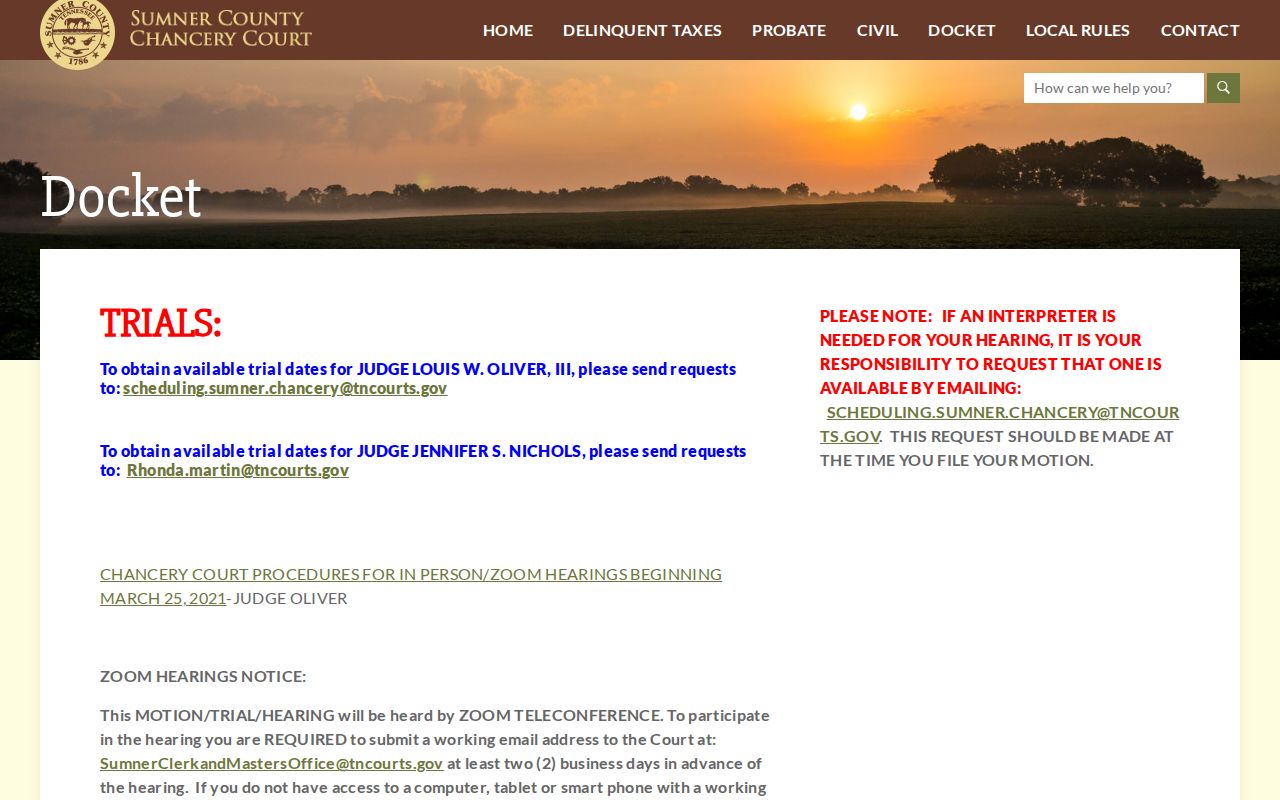
Here is why a Circuit or General Sessions search can miss a live Sumner County civil case. The record simply sits in a different office. When the subject and the filing court point to Chancery, search that channel for the case docket instead.
Sumner Civil PDF Needs Its Order
For civil docket dates, motion categories, forms, and local scheduling material, the official Circuit Court page is the place the court itself keeps current:
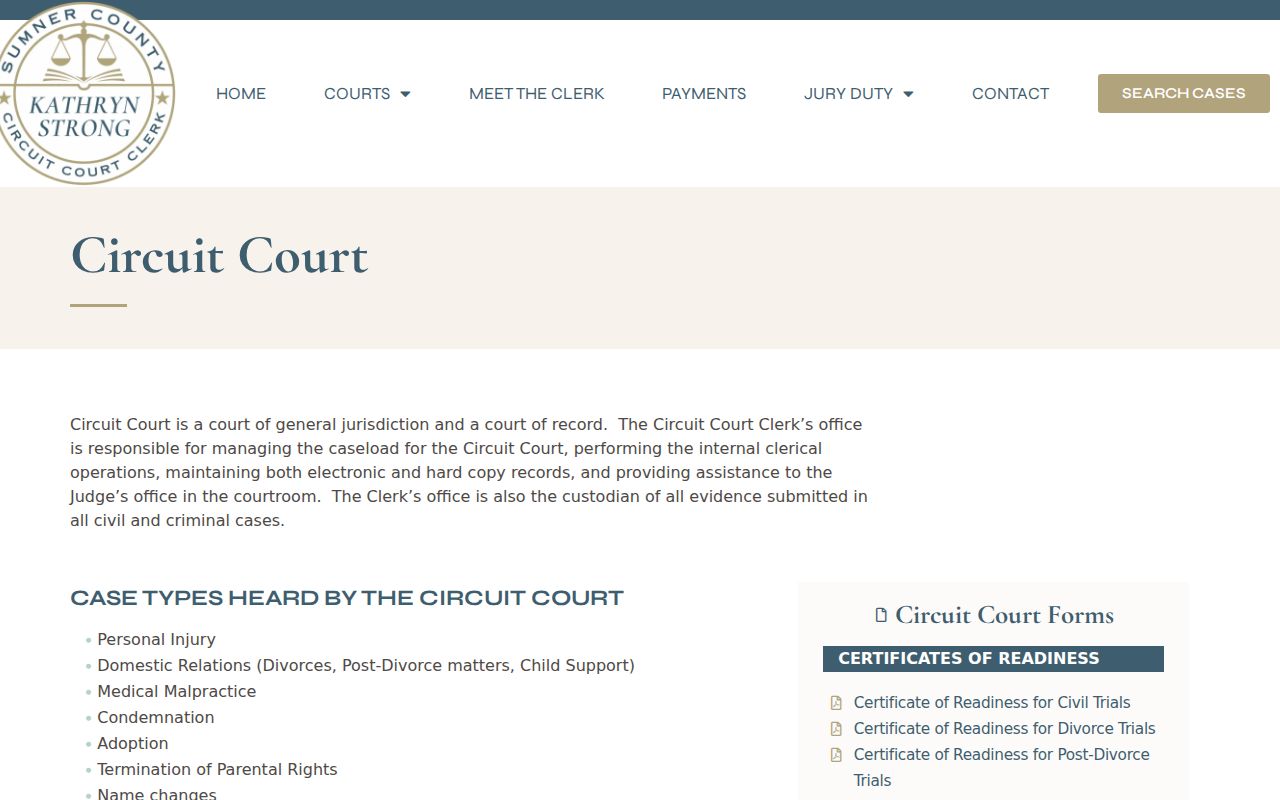
A docket view can locate a setting, but the signed order behind it controls. Treat the entry as a pointer. So if the Sumner County civil docket lists Motion for Default, Settlement, or Rule 41, ask for the later order before stating any result. Motion entries are requests, not rulings.
Fees have their own quirks too. The Circuit fee sheet lists $25 for certain post-judgment requests and $5 for certification or seal. Neither figure is a judgment balance, and neither replaces a current quote from the clerk. Copy charges sit apart from filing fees as well.
Record check: A daily setting list, chronological register, filed document, and certified copy answer different questions. Request the item that proves the fact needed.
Public Access to Civil Dockets
Two rules govern who can see what. Tennessee Supreme Court Rule 34 opens public court records to view. It still honors confidential records. Those can be sealed by statute, rule, protective order, or sealing order. Tennessee Rule of Civil Procedure 1A goes further for civil court records. That rule presumes them open. Access yields only when a specific serious and substantial interest outweighs it, and no less restrictive option can protect that interest.
Getting at a Sumner County civil docket takes several routes. The county portal works. So do daily PDFs, phone help, the clerk counter, the public terminal, and mailed or written copy requests to the responsible filing clerk. One caution applies. The Tennessee Public Records Act route does not make the county records office the civil court custodian, and Sumner County directs court requests to the clerk where the case was filed. Spell out what you want. Inspection, plain copies, certified copies, the register, a judgment, and an audio record are distinct requests. Some files stay closed to the general public. Juvenile, adoption, protected family, sealed, and redacted material stays off limits.
Public access: Tenn. Code Ann. § 10-7-503 supplies the public-record baseline, while court rules and specific confidentiality laws still govern the file.
Tenn. Code Ann. § 10-7-505 provides a judicial-review path for a qualifying access denial.