
How to Search Criminal Dockets
The main name and number search runs through the Sumner County Online Court Records System. Pick General Sessions or Circuit Court as the court type. Then pick Criminal as the case type. A party name fits the Party Name/Case Reference box. Prefer a numbered search? Enter the year and the final numeric part of the case number. Skip the whole formatted reference.
Date-based PDFs on the Circuit Court Clerk's court site give you a second online route. Still nothing? Call 615-452-4367 extension 2 for General Sessions criminal and traffic. Extension 5 covers Circuit Criminal. The clerk counter and a public terminal allow in-person review. Copy requests go to the Circuit Court Clerk. Very old records may sit with Sumner Archives. A city citation belongs with the municipal clerk who issued it.
- Choose the court level before entering a name or number.
- Set Case Type to Criminal and narrow the year when known.
- Compare the result with the date-specific criminal docket PDF.
- Read each count, setting, and later disposition separately.
- Ask the clerk for the filed judgment or a certified copy when formal proof is needed.
Sumner Criminal Case Number Codes
One General Sessions example reads 83GS1-2025-CR-1687. Here 83GS1 marks the General Sessions series, the year comes next, and CR flags the criminal segment. Circuit Criminal cases carry an 83CC1 prefix instead. These codes tell you the court and case type. They say nothing about the outcome.
The portal's Case Number field wants just the final number. Older full references tend to work better in the Party Name/Case Reference box. Mismatch the court prefix and the selected court type. A valid Sumner County criminal docket can appear blank. Check both fields before trusting an empty result as proof no case exists.
- CR
- The criminal segment in observed Sumner case numbers.
- 83GS1
- The observed Sumner General Sessions prefix.
- 83CC1
- The observed Sumner Circuit Court prefix.
- Cont'd
- A continuation that should be checked against a newer setting or order.
What a Criminal Docket Shows
Each Sumner County criminal court docket PDF opens with the court office, generated date and time, hearing date, hearing time, judge, and page count. Case blocks follow. A block can list a case number, a State of Tennessee versus defendant caption, officer or witness roles, numbered counts, and plain-language offense labels. Several counts still share one case number. Read each count on its own.
| Case number | The local court prefix, year, CR segment, and final number. |
|---|---|
| Count and offense | Each numbered allegation and its plain-language charge label. |
| Setting | The hearing date, time, judge, and any stated event type. |
| Party roles | The State, defendant, and any officer, witness, or attorney role shown. |
| Disposition | A later plea, dismissal, conviction, diversion, sentence, or appeal entry when available. |
The daily PDF carries no separate statute column, bond field, full attorney data, financial balance, or link to document images. Those details live in the case register or the filed papers. The PDF is a court calendar record, not the entire file.
Sumner Offense Levels Choose Court
Sumner County General Sessions Court hears misdemeanors. It also holds preliminary hearings in felony matters. Sumner County Criminal Court takes felony cases and criminal jury trials. A preliminary hearing entry in General Sessions does not keep the felony there through judgment. Later felony settings may show up under the Criminal Court layer instead.
| Venue | Criminal docket work | Public route |
|---|---|---|
| General Sessions | Misdemeanors and felony preliminary hearings | tncrtinfo, daily PDF, extension 2 |
| Criminal Court | Felony cases and jury trials | tncrtinfo, calendar links, extension 5 |
| Municipal court | City citations and ordinance matters | Issuing city's portal or clerk |
| Appellate court | Review after a trial-court case | Tennessee Public Case History |
Under local rules, the Sumner County Circuit Court Clerk keeps the papers for Criminal Court. City clerks hold their own municipal dockets. That split explains why a city ticket may never surface in a county criminal search.
Stages on a Criminal Docket
A criminal docket develops over time. The usual record flow is: Filing or charge → Initial appearance or arraignment → Pretrial setting → Plea or trial → Disposition → Sentencing. General Sessions may add a preliminary hearing before a felony proceeds to Criminal Court. The daily list may capture only one point in that chain.
An offense label is only an allegation until a disposition is entered. A plea, trial, dismissal, nolle prosequi, diversion, or conviction supplies the later outcome. Sentencing and costs can follow a conviction. For the exact result, read the filed judgment. A setting labeled Settlement, Motion, or Trial Jury shows what was scheduled. It never shows what the judge decided.
Sumner Weekly Criminal Docket Rhythm
The official General Sessions page groups settings by subject across the workweek: criminal, traffic, state-trooper, wildlife, and driving-suspended or revoked matters. That pattern helps you pick the likely list, though the current entry still controls the actual date. The official weekly docket source shows how Sumner County separates those calendar streams.
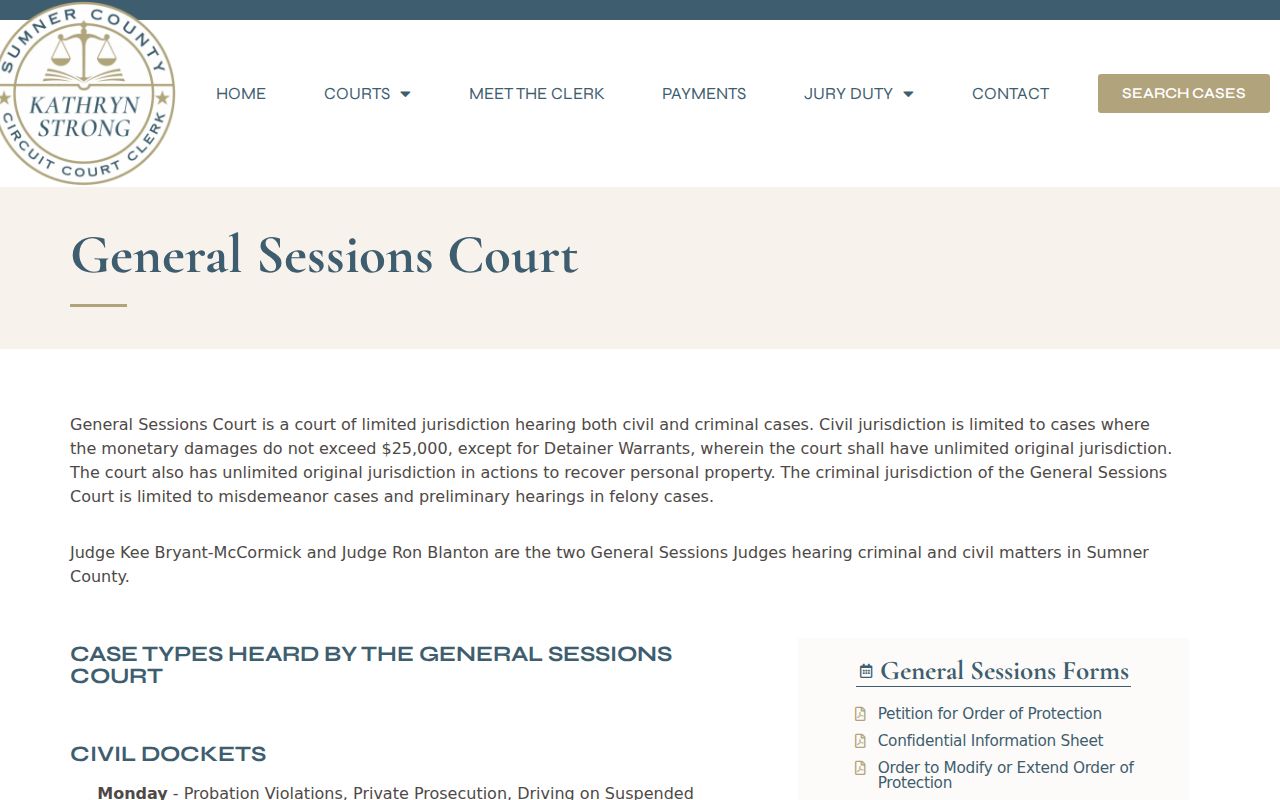
One court, then, can publish several subject-based lists. Always match the case number and judge to the newest Sumner County criminal docket entry before relying on a date.
Which Court Holds Criminal Dockets
Which office holds the record depends on the issuing agency, the offense level, and the stage. General Sessions keeps its misdemeanor and preliminary-hearing record through the Circuit Court Clerk structure. Criminal Court holds felony and jury proceedings. Municipal clerks keep city ordinance and citation matters. Juvenile Court handles delinquency and related youth matters. Access rules there differ from open adult criminal dockets. For felony and jury settings, the Sumner Criminal Court source links judge calendars and court information.
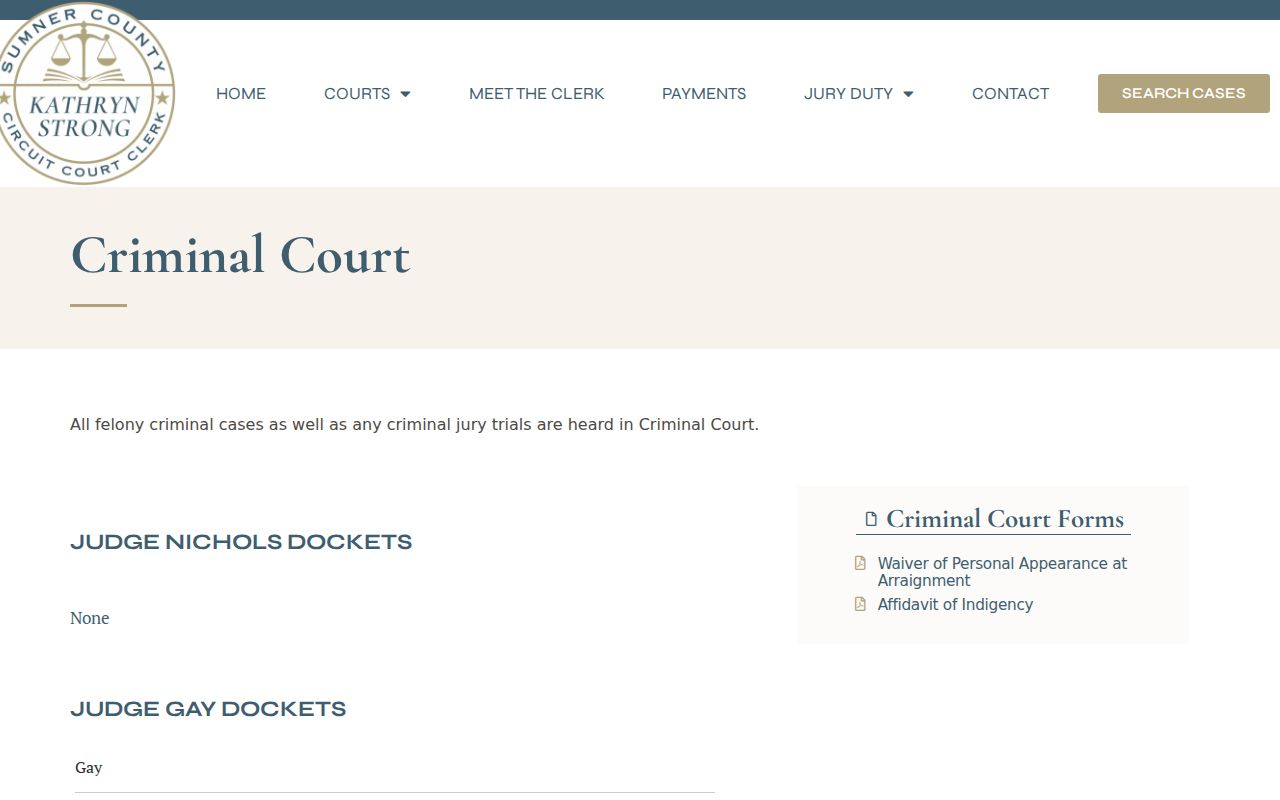
That layer covers the Criminal Court calendar only. The clerk's register and filed orders stay authoritative for a plea, dismissal, sentence, or appeal.
Sumner Docket Versus Criminal Judgment
It is easy to read too much into a line on the docket. Take “Failure to Appear.” That entry tells you nothing about the base case. It does not show a reset, a warrant, or a later fix. “Cont'd” works the same way. It means the hearing was continued. But the new date lives in a later record, not on that line.
Need the real outcome? Request the judgment, disposition, or order that was actually filed. A certified copy comes with the clerk's seal and authentication. Sumner Circuit charges $5 for a certification or seal, per its fee sheet. Have the clerk confirm the current copy total. Do that before you pay. The docket may point to a filing that is not online. If so, the wider Sumner County court records process takes over from there.
Key distinction: A charge is not a conviction, and a hearing setting is not a court ruling. Follow the docket to the filed outcome record.
Sumner Appeals Form a Second Docket
Ordinary lower-court criminal cases in Tennessee have no single statewide search. The Tennessee Public Case History site covers appeals only. A Sumner County criminal matter shows up there once it reaches the Tennessee Court of Criminal Appeals or the Tennessee Supreme Court.
An appellate result can be a useful map. It may list the trial-court number, the judge, key milestones, the record, and the appellate disposition. Still, it never replaces the Sumner trial-court register. Run the county system for the original case. Then run the appellate system for the review on top.
Public Access and Sealed Criminal Dockets
Tennessee Supreme Court Rule 34 opens court records to the public, with limits. Statutes, rules, protective orders, and sealing orders can make material confidential. So a missing online result does not mean a dismissal. The case might sit in another Sumner court. It could be older, sealed, expunged, juvenile, or simply outside the portal's coverage.
You still have several ways in. The public channels include tncrtinfo, daily PDFs, a phone call, and the clerk counter. The public terminal is open too. A copy request can go to the filing clerk. A mailed request should name the court, the case number, and a party. It should also list the record wanted and whether you need a plain or certified copy. The county public-records office cannot substitute for the court clerk. Sumner County sends court-record requests to the clerk where the case was filed.
Access rules:
Tenn. Code Ann. § 10-7-503 provides the state public-record baseline, subject to confidential-record laws.
Tenn. Code Ann. § 10-7-505 provides judicial review after a qualifying denial.